

How Past Experiences Block Business Success: A Guide By Peter Szabo
January 23, 2026
Coaching By Peter Szabo: An Insightful Approach To Scaling an Online Business
February 4, 2026Why do two Shopify stores selling similar products produce dramatically different results? Traffic quality matters, but it is rarely the deciding factor. In most cases, conversion performance is dictated by design choices that either reduce friction or amplify uncertainty at critical decision points.
A Shopify store is not just a visual storefront. It is a behavioral system. Every layout decision influences trust, comprehension, and momentum. When those elements work together, visitors move forward confidently. When they do not, hesitation stalls action.
At AICommerce, we have spent years working with e-commerce entrepreneurs across the United States who entered the market with strong intent but inconsistent results. This article breaks down the design elements that consistently convert browsers into buyers. The focus is not on trends or surface-level aesthetics, but on structural decisions that support clarity, confidence, and scalable growth.
Key Takeaways
- Clarity drives conversions more than visual complexity. Stores that guide visitors through a clear decision path outperform designs that prioritize aesthetics over usability.
- Trust must be built at decision points, not buried in footers. Shipping details, return policies, and payment reassurance are most effective when placed where hesitation occurs.
- Product pages should address objections before listing features. Buyers scan for reassurance, and pages that anticipate concerns maintain momentum through the buying process.
- Checkout optimization delivers outsized gains. Reducing form friction, maintaining visual consistency, and offering flexible payment options directly increase completed purchases.
- Scalable design systems protect performance as stores grow. Modular layouts and structured frameworks support delegation, testing, and platform changes without disrupting conversions.
Designing for Cognitive Simplicity and Immediate Orientation
Most underperforming stores share a common flaw: they try to impress instead of guide. Excessive visuals, complex menus, and competing calls to action increase cognitive load. Visitors must work harder to understand what matters.
Research from Google’s UX team shows that users form an impression of a site in under 50 milliseconds. If the page does not immediately communicate structure and purpose, trust erodes. This effect is magnified on mobile, where space is limited, and attention is fragmented.
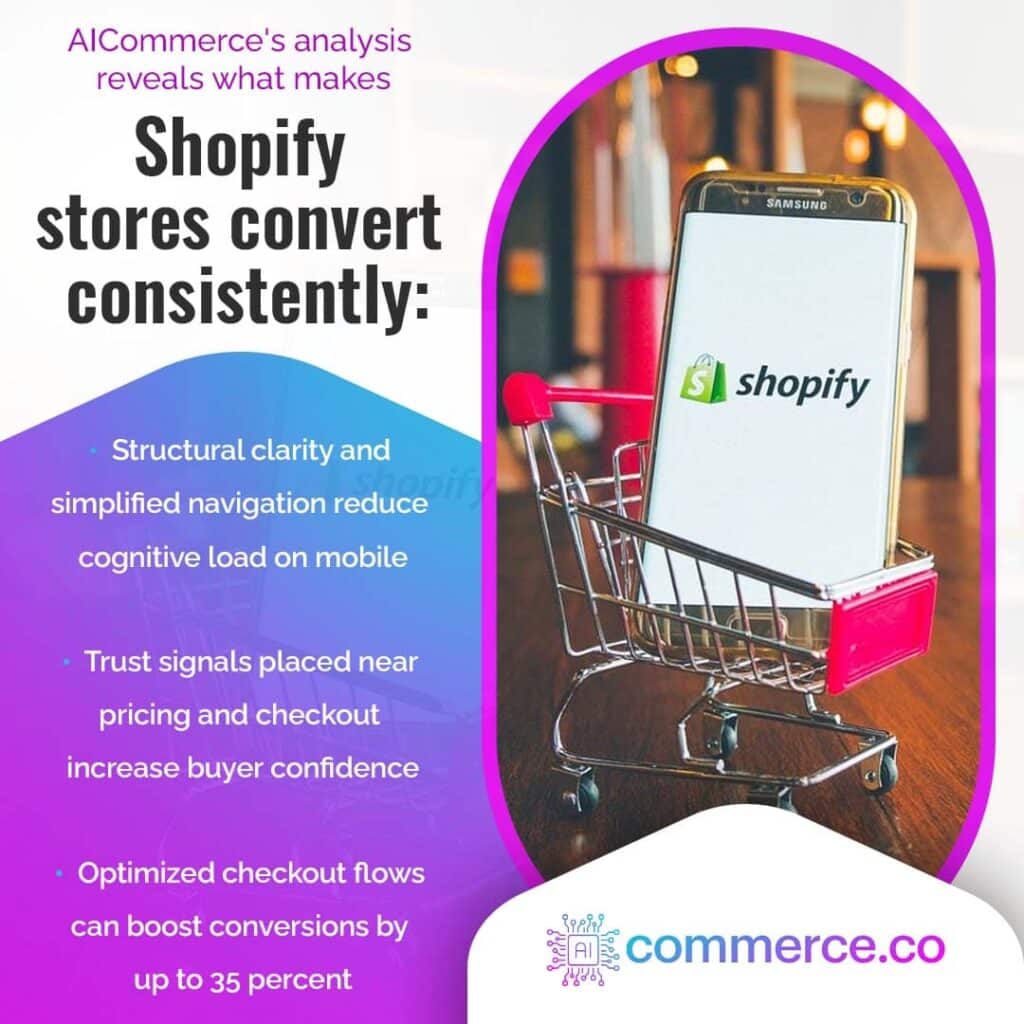
During a Shopify store setup service, foundational layout decisions determine long-term performance. Clear navigation paths, predictable page structures, and restrained visual elements allow visitors to orient themselves quickly. We consistently see bounce rates drop by 20 to 30 percent when stores are simplified around a single decision path.
Why Simplicity Scales Better Than Sophistication
As traffic increases, complexity becomes expensive. Mobile users now account for more than 70 percent of e-commerce sessions. Designs that rely on dense visuals or hidden interactions struggle under scale.
This is one reason many clients opt for a done-for-you Shopify store early on. When structure is validated from the start, testing cycles shorten, and fewer corrections are needed later. Simplicity is not minimalism. It is efficient.
Trust Architecture as a Core Conversion System
Trust is not built through claims alone. It is reinforced through consistency, transparency, and reassurance at the exact moment doubt appears. Most visitors hesitate not because they dislike the product, but because they anticipate friction after purchase.
Baymard Institute research shows that 15 percent of shoppers abandon carts due to unclear return policies. Another 19 percent cite concerns about payment security. These objections are rarely solved with longer explanations. Placement and design carry more weight than wording.
High-performing stores surface trust elements precisely where decisions occur. Shipping timelines near pricing, guarantees near call-to-action buttons, and payment reassurance during checkout all reduce hesitation. Footer placement is largely ineffective because it requires effort to locate.
Social Proof That Feels Earned, Not Engineered
Reviews are only effective when they feel contextual. Testimonials placed randomly create skepticism. Testimonials tied to specific objections build confidence.
When clients ask whether to buy ready-made Shopify store assets or build custom, we emphasize trust placement as a non-negotiable factor. In several cases, reorganizing trust signals alone improved conversion rates by over 10 percent without altering products or pricing.
Product Page Layouts That Preserve Decision Momentum
Product pages are where interest becomes intent. Their role is not to educate exhaustively, but to guide decisions efficiently. Any disruption in this flow creates hesitation.
Headlines must communicate outcomes, not features. Images must answer objections, not decorate space. Supporting sections should anticipate concerns before they surface consciously.
When building turnkey Shopify ecommerce solutions, we rely on modular product page systems. These allow rapid testing of image order, benefit framing, and objection handling without rebuilding pages from scratch. One optimized product page often outperforms several average ones combined.
Designing for Objections Instead of Features
Most product descriptions focus on specifications. High-converting pages focus on friction points. Shipping speed, durability, ease of use, and post-purchase support are common sources of hesitation.
We consistently see higher conversion rates when pages address objections in the sequence they arise mentally. This keeps visitors moving forward instead of looping back into doubt.
Checkout Design That Maintains Confidence Under Pressure
Checkout is the final trust test. Even motivated buyers hesitate if the experience feels unfamiliar or demanding.
Effective checkout design reduces required inputs, offers express payment options, and removes distractions. Visual consistency between product pages and checkout reinforces security. Sudden design changes introduce doubt.
For entrepreneurs evaluating a pre-built Shopify store for sale, checkout customization is often overlooked. This is a costly mistake. Checkout optimization consistently produces one of the highest returns on effort across the entire funnel.
Why Fewer Inputs Produce Higher Revenue
Each additional form field introduces friction. High-performing stores collect only essential information. Optional data can be gathered after purchase. Momentum matters more than completeness at this stage.
Whether stores are built internally or with the best Shopify developers for hire, checkout design must be intentional. In our experience, checkout improvements alone can drive 15 to 20 percent revenue lifts within a single optimization cycle.
Design Systems That Support Delegation and Scale
Design is not a one-time task. It is an operating system that must support growth, delegation, and testing. Rigid layouts become bottlenecks as stores expand.
We prioritize modular frameworks that allow updates without disrupting conversion flow. This is especially important for entrepreneurs building semi-passive income streams. When assistants, ad teams, and fulfillment partners interact with the store, consistency prevents erosion.
This becomes critical during Shopify store migration services. Poorly planned transitions often damage performance temporarily or permanently. Scalable systems preserve momentum through change.
How Done-For-You Builds Reduce Structural Errors
Many early-stage failures stem from incorrect foundational decisions. Layout mistakes, navigation flaws, and trust gaps compound over time.
A professional done-for-you Shopify store eliminates many of these risks by starting with proven structures. This does not remove customization. It removes guesswork. Entrepreneurs begin testing products and messaging instead of fixing architecture.
We have observed that stores launched with validated frameworks reach stable conversion benchmarks faster than those built experimentally. Speed to clarity matters.
Integrating Advertising, Design, and Data as One System
Design does not operate in isolation. It must align with traffic sources and intent. Stores built without considering ad flow often struggle.
When paid traffic enters a store, visitors arrive with expectations shaped by the ad. If the landing experience does not match that expectation, trust breaks. This is why design must support funnel continuity.
Our agency services focus on aligning creative, traffic, and on-site experience into a single system. When messaging, layout, and offer structure reinforce each other, conversion rates stabilize and scale.
Agency Services Structured Around Execution and Scale
AICommerce agency services are designed to remove the most common execution bottlenecks that prevent Shopify stores from converting and scaling. Rather than offering isolated services, the model combines store architecture, traffic execution, and system licensing into a single operating framework.
The focus is not on one-time delivery. It is on building a Shopify environment that can be tested, optimized, and delegated without breaking conversion flow. This structure reflects how successful stores operate in practice, not how they are often packaged.
Services are intentionally tiered so that entrepreneurs can enter at different levels depending on whether the primary constraint is store performance, traffic execution, or operational capacity.
Done-for-You Store Creation and Store Makeovers
One core service is done-for-you store creation or store makeover. This includes branded Shopify store builds, core page architecture, essential plug-ins, conversion-focused copy, and a pre-loaded product structure designed for testing.
These builds are not generic templates. They are structured to support paid traffic from the outset, with emphasis on navigation clarity, product page hierarchy, and checkout simplicity. In makeover scenarios, existing stores are restructured rather than rebuilt blindly, preserving what works while removing friction.
This service addresses a common issue seen in early-stage stores: visually complete builds that lack conversion logic.
Paid Traffic Management Across Single and Dual Platforms
AICommerce also provides ongoing ad management services across one or two major platforms, typically Meta and TikTok. Service tiers differ based on platform scope rather than feature dilution. Core components remain consistent: creative development, campaign setup, split testing, optimization, and funnel alignment.
The distinction between single-platform and dual-platform management is strategic. As stores mature, diversifying traffic sources reduces dependency and stabilizes revenue. Store design decisions are aligned with this reality, ensuring landing experiences remain consistent across traffic types.
System Licensing and Ongoing Execution Support
Beyond services, we offer clients the ability to license their internal systems, processes, and frameworks. This includes store setup logic, product testing methodology, and ad
structure, and operational workflows refined across hundreds of client accounts.
This system-level access is what enables scale without constant reinvention. Clients are not starting from theory. They are implementing structures that have already been tested under real conditions. Ongoing coaching by Peter Szabo and execution support ensure these systems are applied correctly, rather than partially.
Real Client Case Studies as Conversion Anchors
Testimonials work when they remove uncertainty through evidence. For our agency, proof is not abstract. It is documented through client progression, starting conditions, and measurable growth tied to system execution and store structure.
Several brands that later reached seven-figure annual revenue began with modest monthly sales and incomplete Shopify setups. Carved, for example, entered the partnership while generating approximately $15,000 per month. The initial focus was not aggressive scaling, but correcting store structure, simplifying navigation, and aligning product presentation with paid traffic intent. Over time, those foundational changes supported sustainable growth into a seven-figure brand.
Advanced Mixology followed a similar trajectory. The brand engaged AICommerce at the very beginning of its Shopify journey. Early decisions around product page layout, category structure, and checkout flow created a foundation that supported scale without repeated redesign. The store did not rely on visual complexity. It relied on clarity and repeatable systems, which later allowed the brand to grow into seven figures.
These examples matter because they address a core hesitation many prospective buyers experience: whether store design and systems work beyond theory. In these cases, structure preceded scale.
Early-Stage to Seven-Figure Growth Patterns
Across multiple AICommerce case studies, a consistent pattern emerges. Brands that progressed most efficiently focused first on clarity, not expansion. Ascension Brands began its journey with us before achieving meaningful traction. Early-stage decisions around store hierarchy, messaging alignment, and friction reduction allowed traffic investments to convert predictably as volume increased.
Other brands, including Canvas Vows and Rustic Furniture Outlet, entered the ecosystem while generating under $10,000 per month. In each case, store design was treated as operational infrastructure. Product pages were rebuilt to emphasize outcomes. Checkout was simplified. Trust elements were placed strategically rather than generically. These changes supported growth into the seven-figure range without constant reinvention.
How Case Studies Influence Ongoing Store Design Decisions
AICommerce does not treat case studies as static marketing assets. They inform how future stores are built and optimized. When multiple brands succeed after simplifying navigation or restructuring product pages, those insights become design standards.
For example, repeated success among brands selling higher-ticket products reinforced the importance of reducing choice overload. Stores that limited featured products and emphasized clear value propositions converted more consistently. That learning now informs how new Shopify builds are structured from the outset.
Similarly, feedback from brands that scaled efficiently without redesign highlighted the value of modular layouts. These layouts allow product expansion without disrupting conversion flow. As a result, modularity has become a core design principle across our stores, supported by us.
Choose Our Professional Team To Scale Your Business
High-converting Shopify stores are not built on aesthetics alone. They are built on clarity, trust, and momentum. Every design element either supports or undermines these forces.
From navigation simplicity to checkout efficiency, from trust architecture to testimonial placement, conversion is the result of aligned systems, not isolated tweaks. Stores that scale successfully treat design as infrastructure, not decoration.
At AICommerce by Peter Szabo, we apply these principles across our agency services, done-for-you builds, and optimization projects. When traffic exists but results lag, evaluating design through a conversion-first lens is often the most effective place to start. To learn more about our professional turnkey Shopify ecommerce solutions, contact us today at support@aicommerce.co.